
The Writer’s Guide to
Collecting, Generating, Recording, and Developing New Ideas
by Rochelle Melander
Everybody walks past a thousand story ideas every day. The good writers are the ones who see five or six of them. Most people don’t see any.
– Orson Scott Card
Ever get that flash of insight that turns into a book or a million-dollar business idea? Mary Shelley got the idea for Frankenstein from a waking nightmare during a stormy weekend at a mansion. Sara Blakely, the founder of Spanx, had a vision for her undergarments when she snapped off the bottom of a pair of pantyhose to give herself a seam-free look.
But those idea bombs are rare.
As Jack London said, “You can’t wait for inspiration. You have to go after it with a club.”
I like my version better:
“Don’t wait for ideas to come to you.
Chase them with a butterfly net.”
–Rochelle Melander
For most of us, the game changer comes when we create a structure to discover and use ideas.
In today’s post, I’ll give you the tools you need to discover, generate, record, play with, and use your ideas.
Develop an Idea Recording System
Before collecting ideas, create a system for recording and categorizing them. I recommend that everyone have:
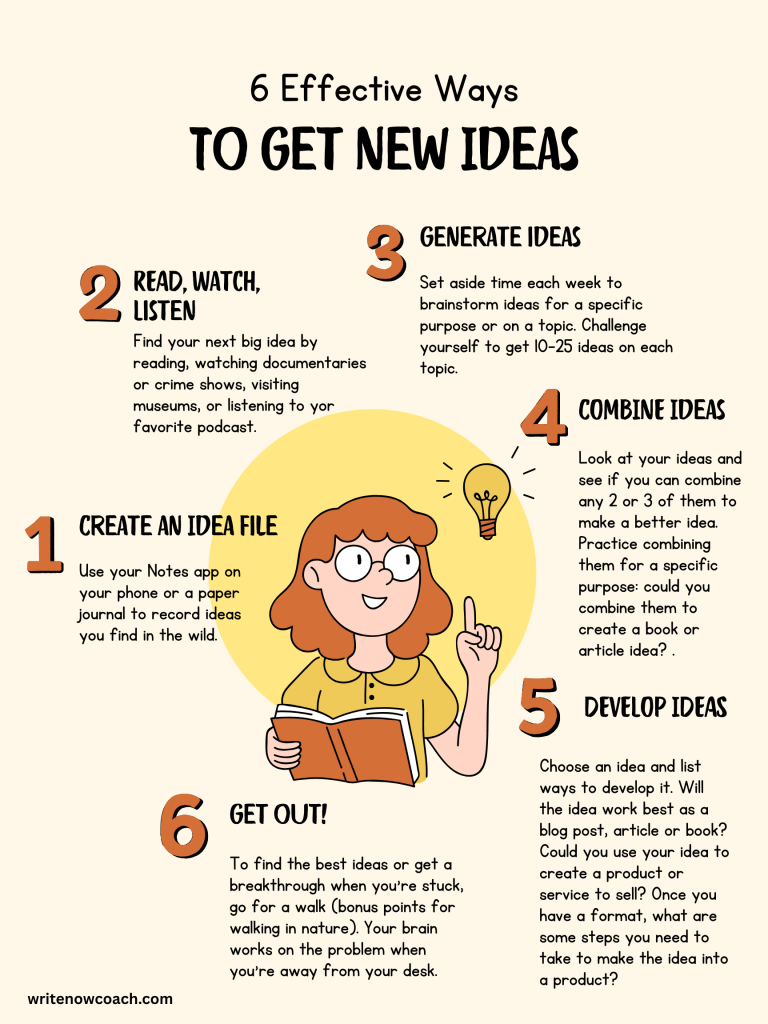
+A tool for recording ideas on the road. When you’re in the car or doing errands, ideas buzz around your head like flies on food. Use a tiny notebook, index card, or a note-taking app on your phone to record the ideas. You can also use an app like Evernote or Notion to take notes and collect your research, that can be a good place to record your new ideas.
+An idea journal or file. Use a big notebook, a computer document, or a combination of both to hold your ideas. Divide your notebook or document into different sections so that you can organize ideas by project or category. A networking consultant who has a blog and is writing a book might have an idea file with categories like “blog ideas,” “book on ideas for how introverts network,” “business marketing ideas” and “random ideas.” A novelist might have a section for their current novel, a section of ideas for future novels, a section for random ideas about character, setting, and situations.
+A journal, section in your notebook, or a separate document where you can play with ideas. I get the most out of ideas when I can play with them—stretch and bend them, combine them with other ideas, and apply them to a bunch of different formats. I use a big sketchbook and a bunch of colored markers and pens to play with ideas.
Collect Ideas
As Card said, we walk past dozens of ideas a day. If we’re smart, we jot them down. (Or, as writers like Elizabeth Gilbert has said, they tend to fly away and tempt the writer down the block who is paying attention!) But in addition to collecting the ideas that show up for us, we need to spend time purposefully gathering ideas. Here are some thoughts about where to look for new ideas.
Linda Formichelli and Diana Burrell, authors of The Renegade Writer, suggest that writers steal ideas from:
- Newsletters
- Government Reports
- Press releases
- Trade magazines
- Regional magazines and newspapers
- Consumer magazines
- Books
- Your articles
I often find ideas in:
- Newspaper articles
- Blog posts
- Facebook and Twitter posts
- Posts from groups on yahoo and LinkedIn
- Overheard conversations
- Book titles
- Music lyrics
- Art exhibits
- Google’s auto complete
- Idea networks like Springwise or Trendwatching
Practice Generating Ideas
I find it helpful to set aside time each week to generate ideas. I usually do this around a specific topic (What blog posts could I write? What classes could I teach? What might my protagonist do next?). It can also be helpful to simply play with generating ideas because the more you generate ideas, the better you become at thinking up new ideas.
Nonfiction
Ten ways to solve…
Ten things I’ve learned this year
Ten practices or values I feel strongly about
Ten essays I could write immediately
Ten things I am curious about
Fiction
Ten actions my character could take to try to solve their problem
Ten things my protagonist might say
Ten places my characters could visit
Ten awkward situations I’d love to write about
Ten ways to mash up genres
Ten short or flash fiction stories I could write immediately
Play with Ideas
Many of us have the notion that the brilliant writers receive their ideas fully formed. But that’s not true. Most ideas start out kind of wobbly (like people) and get better when they are combined, developed, or questioned.
+Combine. Look at your ideas and see if you can combine any 2 or 3 of them to make a better idea. Practice combining them for a specific purpose: could you combine them to create a book or article idea?
+Develop. Play with one of your favorite ideas and list ways to develop it. Will the idea work best as a blog post, article or book? Could you use your idea to create a product or service to sell? Once you have a format, what are some steps you need to take to make the idea into a product?
+Question. The Renegade Writer presents good questions to help you take an existing article, book, or press release and put your own spin on it.
- How could you do this better? Can you write something that covers the holes in the story?
- What is the opposite of the story? If you come across a story on how children consume too much media, and it’s ruining their brains, maybe you could explore a story on how media is good for young people. Or you could go deeper, and try to figure out how children who forgo media are smarter than their peers.
- Who else would be interested in this story? Can you take a secular story and put a religious spin on it? Can you take a press release and slant it so that it works for a parenting magazine, a blog for seniors, or a food magazine?
- How can I make this idea regional?
- How can I make this idea national?
- How can I make this idea narrower?
- How can I make this idea broader?
- How can I make this idea fit my target market?
Use Your Ideas
Most of us have dozens of notebooks filled with ideas that we never act on.
Don’t hoard ideas.
Instead, take this quote from Annie Dillard and put it on your wall, “Spend it all, shoot it, play it, lose it, all, right away, every time.”
Before you write, gather up some of your ideas.
Then toss them in your writing.
Don’t be stingy. You won’t run out.
If you do, you can find more ideas tomorrow.
Pro Tip: If you are blocked and don’t know HOW to develop your ideas into a story, walk away from them. They tend to grow and combine on their own.
Wrap Up
Writing requires idea development. Make idea gathering a part of your weekly or monthly schedule!
If you need help brainstorming ideas or strategizing which ones might work for your audience, consider signing up for a coaching session. Message me.
TL;DR
Don’t wait for ideas to come to you.
Chase them with a butterfly net.”
Develop an idea recording system. (Like your Notes App.)
Collect ideas. Go out into the wild or dive into books and music to find gems.
Generate ideas. This practice will help you become a better writer.
Play with ideas. The best ideas come from combining, questioning, and developing.
Use ideas. Don’t let your ideas rot in a file. Give them a job!
Connect with me for support.
Write Now! Coach Rochelle Melander is an author and ADHD-trained professional certified coach. She helps wildly creative people get stuff done. From writing and publishing books to finishing that work project–she’s got you covered. If you’re struggling to start or finish a project, connect with Rochelle to create a personalized plan for overcoming procrastination, dealing with distraction, and staying focused. Book a private consultation: https://writenowcoach.com/consultation/