An Interview with Poet Michele Wolf
by Rochelle Melander
Tell our readers about your new book of poems, Peacocks on the Streets.
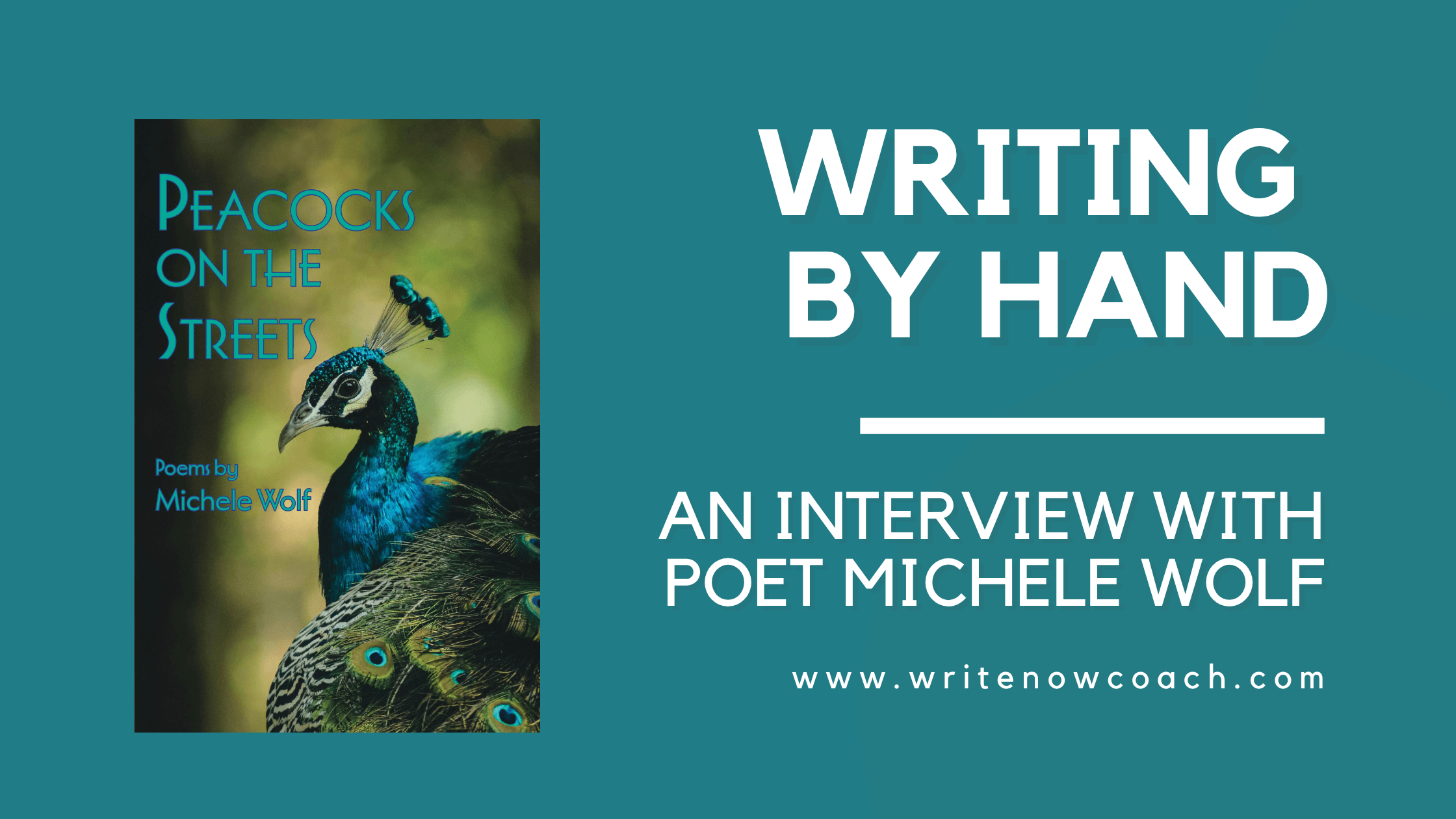
The book’s title and my poem “Peacocks on the Streets” are based on that time during the early months of the pandemic when we were all quarantined at home and the streets were so empty that, worldwide, wildlife ventured out of their natural habitats to visit residential and commercial spaces. I found these new wildlife behaviors quite evocative, especially when juxtaposed with the danger and wildness of COVID. Peacocks on the Streets explores what is wild and unpredictable in our lives — both what is harsh and what uplifts us — and how we find the resolve to triumph after trauma. The poems’ subjects range from pandemic bereavement, hate crimes, and terrorism, to falling in love at midlife, adopting a child, and caring for a parent stolen by dementia. In a word, Peacocks on the Streets is about resilience.
What is your process for writing poems?
The initial step, typically, is I am struck by an image or an experience that feels layered with meaning and possibilities, something I want to explore further. For the early stages of a poem, my standard ritual is I write with a pencil on a white, 8.5- by 11-inch, blue-lined pad. There is something about handwriting poems when they are still unformed that seems very essential and back-to-basics to me, that helps lead me to the core of what I want to express.
Early on in a poem’s development, I do a lot of free association and note down everything that comes to mind, even though I will end up using only a fraction of this material. I try not to edit myself at this point. The pencil reminds me that what I’m writing is still tentative. I don’t commit a new poem to its computer iteration until it is nearly completed. For prose — personal essays, reviews, and features — I compose on the computer.
Throughout the years, how have you managed to both write poems and work as an editor? Can you talk about how you juggled the two roles and what practices you had in place to maintain your creative output?
I’ve succeeded in handling both roles because I’ve compartmentalized. I held full-time staff jobs as an editor for many years, until 2023. Now I am an independent editor, working with multiple clients but deliberately working only part-time. This flextime, in theory, offers me more time for writing poems, but most of my free time has been eaten up lately by the fun task of getting the word out about Peacocks on the Streets.
My key tip to maintaining creative output is to schedule in writing time on your calendar, just as you might schedule in exercise time, even if it’s only for half an hour a couple of days a week. During many of the years when I worked full-time, my daughter was under age 18, so I also had welcome parenting responsibilities in the mix. My solution was to tune out my surroundings and write during my one-hour Metro commute from my D.C. suburb into downtown, and then during the one-hour ride heading back home. I got a lot of work done! A friend nicknamed me the Red Line Poet.
From your years of work as an editor and poet, what are some self-editing tools you use or encourage writers to use?
One reason I like writing poems in pencil in their early stages is that there’s less of a temptation to omit something by writing over it and thereby losing an earlier iteration of a line or more, which may be valuable to turn to again. Sure, I cross things out in pencil, and a poem’s full history can certainly be preserved on the computer, but I prefer having a wad of pages to work with in my hands rather than on the screen.
Also, once a poem — or a prose piece — is near completion, I am ruthless with every word of it: Is it essential? Is it the perfect, can’t-be-anything-else word? With prose, is there something important and rich in every sentence? With poems, is there something important and rich in every line? No filler allowed.
You’ve been an editor for many years. What tips would you give to writers about working with an editor?
In 99 percent of cases, your editor is your friend, someone whose goal is to help your writing achieve its highest potential, not to imbue it with their personal stamp. Their goal is to make your voice the best it can be. A great many editors also write and are sensitive to both roles and very respectful.
The key thing to remember is that no matter how polished your writing is, you are so close to it that you may have blind spots, and an editor can help you by offering suggestions for improvements. Keep an open mind regarding the back-and-forth of the editing process. The bottom line is, this editor has already accepted your work for publication. Hooray! This editor has taste. That’s a given.
What are you reading now?
I am enjoying poet Traci Brimhall’s Love Prodigal. Two novels I was recently very taken with are Alice McDermott’s Someone and Colm Tóibín’s Long Island. Also, I am rereading poet Barbara Ungar’s After Naming the Animals and poet Richard Levine’s Now in Contest.
For those in the New York City area, I’ll be giving a poetry reading with Barbara and Richard on Saturday, September 19, at the Hudson Park Library, 66 Leroy Street, in the West Village, from 2:00 to 4:00. I hope you can make it! Check out A Poetry Afternoon With Michele Wolf, Richard Levine, and Barbara Ungar. [Link: https://www.nypl.org/events/programs/2026/09/19/poetry-afternoon-michele-wolf-richard-levine-and-barbara-ungar]

About the author. Michele Wolf is the author of Peacocks on the Streets, a finalist for the Paterson Poetry Prize. Her earlier collections are Immersion, Conversations During Sleep, and the chapbook The Keeper of Light. Her poems have appeared in The Southern Review, Poetry, The Hudson Review, and many other literary journals and anthologies. Among her honors are the Anhinga Prize for Poetry, a Maryland State Arts Council literary arts Independent Artist Award, and fellowships from Yaddo, the Edward F. Albee Foundation, the Virginia Center for the Creative Arts, and the Arts and Humanities Council of Montgomery County, Maryland. She teaches at The Writer’s Center in Bethesda. Her website is http://michelewolf.com.