

by Rochelle Melander
I hear many horror stories about critique groups. Writers attend a group hoping for helpful feedback and receive harsh criticism, misinformation, or personal attacks. After one or more challenging experiences like that, many writers avoid critique groups, feel anxious about getting critiqued, or give up on writing.
But it doesn’t have to be that way. I’ve been a member of several successful critique groups that have helped me improve my writing skills. For many years, I’ve been running a positive, helpful critique group that members look forward to attending.
This post gives you a guide for creating a critique group that will inspire you to create better books.
How to choose participants
Thriving critique groups start with the right group of people.
+Choose participants who are writing in the same or similar genres so that group members can offer informed feedback. It’s tough to comment on a genre we know nothing about.
+Look for members who have a similar level of experience as writers.
+Appoint a mentor or group leader who has more expertise and can keep the group on track.
How to set guidelines
Once you have your group in place, it is helpful to have some guidelines to follow. They might include:
+What will meeting look like? One of my picture book critique groups critiques via email. My Write Now! Coach critique groups meet on Zoom, but we always review each other’s work ahead of time. When, where, and how often will you meet?
+Consider how often members will submit and how many pages or words each submission can have. Some groups invite members to take turns submitting. Other groups have members submit a limited number of pages for each meeting. How often will members submit? How many pages each time?
+If you meet and critique multiple manuscripts, either in person or online, how much time will each person get at the meeting?
How to find a critique group
I’ve been in several critique groups over the years. I’ve found them through chance, writing friends, writing coaches, and membership organizations. Here are the best ways to find a critique group:
+Writing membership organization. My current critique group is through the Society of Children’s Writers and Book Illustrators (SCBWI). If you belong to a writing membership organization, check their website to see if they offer critique groups.
+Colleagues. Do you hang out with other writers? If you have friends, colleagues, or writing partners who are at about the same level of experience, you might start your own group.
+Writing classes. Many writing classes include an element of critique. Whether offered through a local college extension program, a writing studio, or online, these groups are often moderated by an experienced teacher.
+Write Now! Coach. I currently offer a critique group and will be expanding that in the fall. Keep your eyes open for future opportunities.
How to critique others
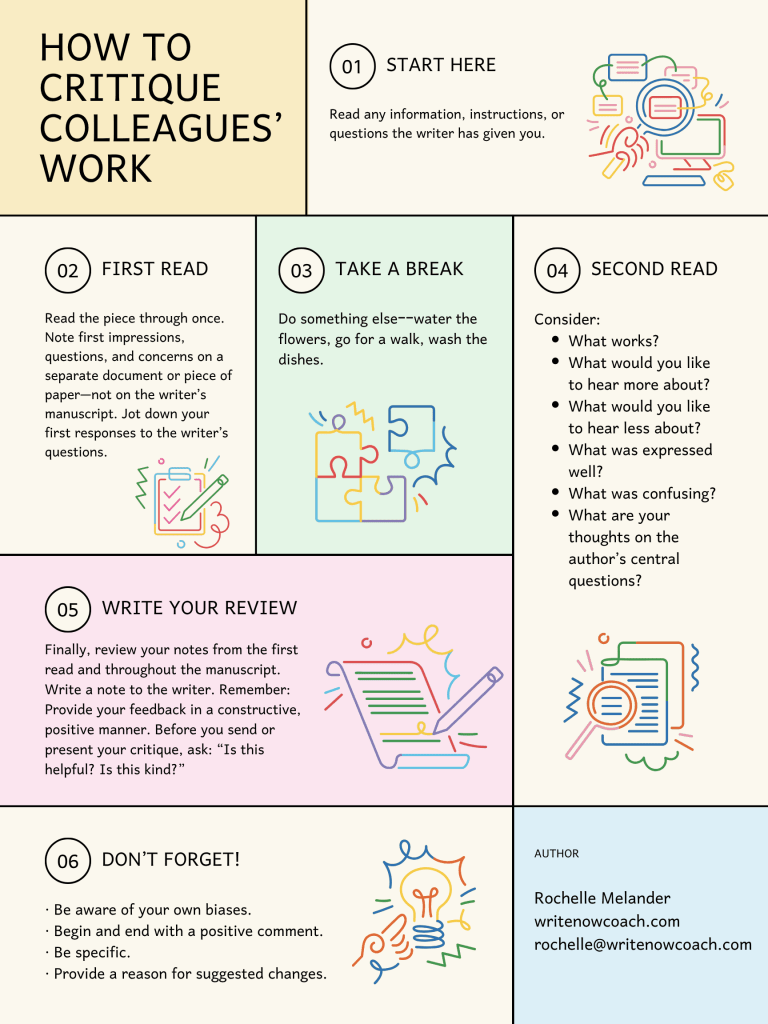
It’s tough to know how to critique. Some of us tend to read for meaning while others are concerned about word choice or grammar. We certainly bring our own ideas as well as biases to our critiquing. Here are some suggestions on how to critique that I developed for my group:
1. Review any information that the author gave you.
2. Read the piece through once. Note first impressions, questions, and concerns on a separate document or piece of paper—not on the writer’s manuscript. Jot down your first responses to the writer’s questions.
3. Take a break.
4. Read the piece a second time. Make notes in the manuscript.
Consider:
- What works?
- What would you like to hear more about?
- What would you like to hear less about?
- What was expressed well?
- What was confusing?
- What are your thoughts on the author’s central questions?
5. Finally, review your notes from the first read and throughout the manuscript. Write a note to the writer, answering their questions and addressing the questions above that pertain to this piece of writing. As you offer feedback, remember:
- Be aware of your own preferences and biases.
- Always begin and end with a positive comment.
- When you give feedback, try to be specific. Instead of, “This is a fun story,” offer concrete information: “When you talk about your cooking disasters, I laughed. The way you heighten tension with each disaster being bigger than the previous one works really well.”
- Provide a reason for suggested changes.
- Provide your feedback in a constructive, positive manner. Before you send or present your critique, ask: “Is this helpful? Is this kind?”
How to receive criticism
- It’s natural to get defensive, overwhelmed, or frustrated. Take a deep breath and remember that the feedback is about this draft and not about you, your talent, or your potential as a writer. Resist the urge to defend yourself or your manuscript.
- Ask clarifying questions. Instead of ranting about what doesn’t work for you, try asking a question like, “Can you say more about this suggestion?”
- After receiving critiques, take a break before you make changes.
- When you get back to your manuscript, consider the feedback and how you might apply it to your draft. Create a new document and try out whatever parts of the critique make sense to you. Dismiss what does not work.
Download this chart to help you critique well.
Write Now! Coach critique groups begin again in the fall. CONTACT ME if you’re interested in joining the waiting list.

Write Now! Coach Rochelle Melander is an author and ADHD-trained professional certified coach. She helps wildly creative people get stuff done. From writing and publishing books to finishing that work project–she’s got you covered. If you’re struggling to start or finish a project, connect with Rochelle to create a personalized plan for overcoming procrastination, dealing with distraction, and staying focused. Book a private consultation: https://writenowcoach.com/consultation/