Writers@Work: Writing Poetry
An Interview with Renée M. LaTulippe
by Rochelle Melander
Congratulations on your new book, LIMELIGHT. Can you tell us about it?
Thanks so much for having me, Rochelle!
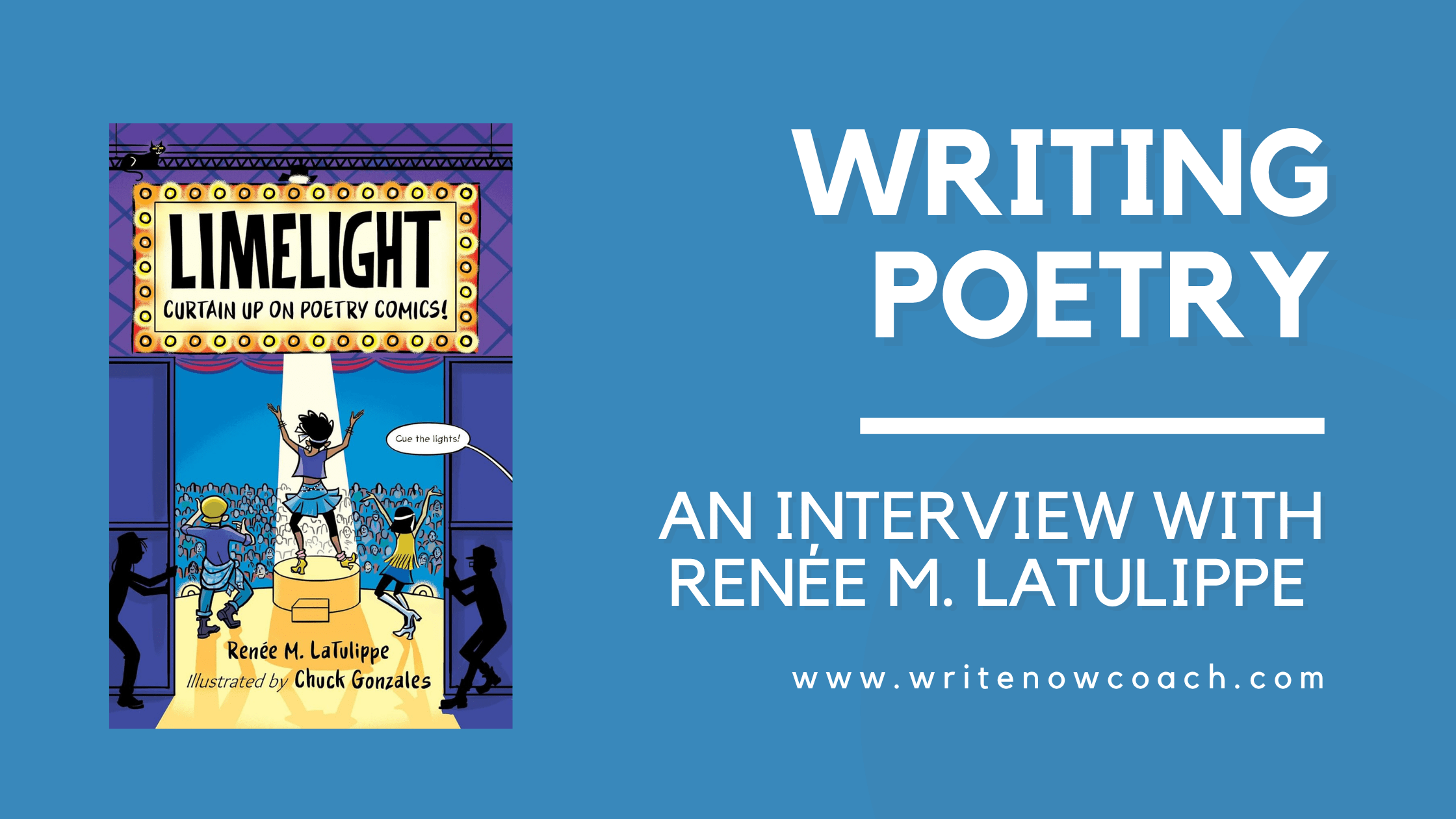
Limelight: Curtain Up on Poetry Comics! is a genre-blending collection of mask poems about theater, presented in a graphic novel format. Most of the poems are written in the voice of some part of the theater, so we get a front-row view of the feelings, thoughts, concerns, and joys of the stage, the curtain, the rehearsal piano, the dressing room mirror, and so on.
From Rochelle: A mask poem is written from the point of view of an inanimate object, animal, or another person (not you).
What inspired you to write LIMELIGHT?
I have a decades-long background in theater in some form, from performing, directing, and producing to teaching both high school and adult theater classes. And in between, I did just about everything else you can do in a theater, from sweeping the stage to designing lights, painting scenery, sewing costumes, and running a box office. I’ve always believed that anyone who does theater needs to wear all the hats at least once to gain a full understanding of what it takes to put on a show. The fact that I loved wearing ALL the hats certainly informed the writing of LIMELIGHT!
I also love writing mask poems, so it was fun to walk in the shoes of all these theatrical elements and give them a voice. Each of the poems is like a monologue, ready to be performed!
I know you run Lyrical Language Lab. Can you talk about that and why it’s important for writers, especially children’s writers, to receive training in writing with musicality?
I developed the Lyrical Language Lab in 2014 because I saw a gap in the study of creative writing. There are a gazillion classes on how to develop characters and plot, but nothing laser-focused on language and how to use it most effectively. In short, it’s about nitty-gritty craft.
The course helps writers train their ear for rhythm, rhyme, and lyrical language, and to use poetic techniques to convey story, emotion, and meaning through lyrical language, whether it’s in verse or prose.
That’s important particularly for kidlit writers because we need to create books and poetry with musical, read-aloud language that will transport children (and their parents) into a world of imagination—and we have to do it in as few words as possible!
I think all writers can benefit from playing with poetry. What tips do you have for writers who want to add some musicality to their writing?
Read a lot of free verse poetry. Free verse poems are great models for conciseness since they must convey big concepts in tiny spaces. They also help train your ear for non-rhyming rhythm and sound.
Pay attention to word choice. Every word must have a purpose and be the strongest and best word for the job. This is where both connotation and synonyms come into play.
Pay attention to the soundscape you’re creating. While picking and choosing your best words, make sure the sounds are cohesive with the content.
And of course, check out my free teaching on the subject on my Peek & Critique channel on YouTube!
What are you reading now?
I usually read one book at a time, but I currently have several going, including Identical by Ellen Hopkins, Furiously Happy by Jenny Lawson, and Nobody’s Girl by Virginia Giuffre.

About the Author: Renée M. LaTulippe is the author of Limelight: Curtain Up on Poetry Comics!, The Crab Ballet, and a forthcoming free verse picture book with Creative Editions, and has poems published in many anthologies. She is the founder of The Lyrical Language Lab and the Peek & Critique YouTube channel. She lives by the sea in Italy with her husband and three children. Visit her online: https://www.reneelatulippe.com/
(Photo credit: Lorenzo David Masini)