Stop Staring at the Blank Page: Why Prewriting Is a Game Changer
by Rochelle Melander
There’s more than one way to look at a blank page.
Gaston Bachelard wrote:
A word is a bud attempting to become a twig. How can one not dream while writing? It is the pen which dreams. The blank page gives the right to dream.
G.K. Chesterton had a completely different view:
The blank page is God’s way of letting us know how hard it is to be God.
Do you panic at the sight of the blank page?
There’s hope.
The promise of prewriting
My life changed when I learned about prewriting. Despite my excellent education, not one teacher (that I can remember) explained to me that writers didn’t just sit down and dash off a masterpiece, like they do in the movies.
Instead, authors think on paper, filling notebooks with their ideas. Then they write. And rewrite.
I’m not alone. Even famous authors practiced prewriting. John Steinbeck kept a journal for each novel. J.R.R. Tolkien drew detailed maps of middle earth. Ursula K. Le Guin made maps of her fictional worlds before she wrote a book. William Faulkner wrote the outline of his book A Fable on his office wall in red crayon. Joseph Heller created a detailed handwritten spreadsheet for his book Catch 22.
Prewriting prevents writer’s block
Often writer’s block is simply a moment of fear—what do I say? Eliminate that anxiety by planning. Before facing the blank page, record ideas for your article or chapter. Here’s how.
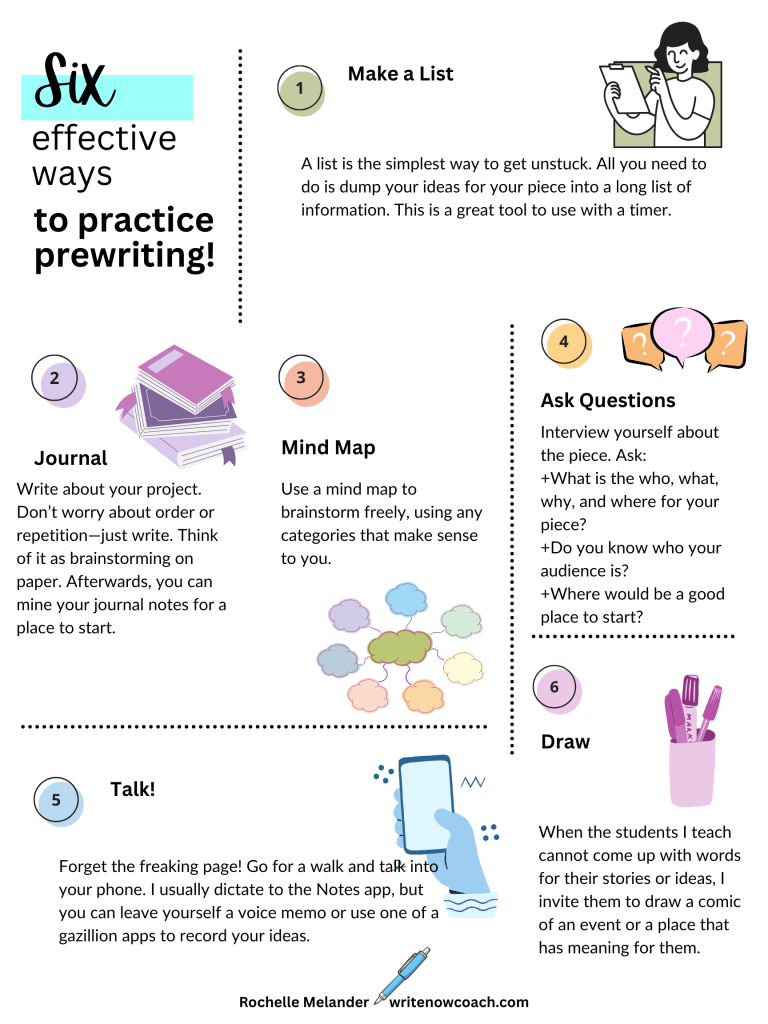
List. A list is the simplest way to get unstuck. All you need to do is dump your ideas for your piece into a long list of information. This is a great tool to use with a timer.
Journal. You may not be able to write your piece yet, but you can journal. “What?” you ask. “They’re the same thing!” Kind of. Think of your journaling like morning pages—one to three messy pages about anything going on in your life. Except this time, you’re going to write about your project. Don’t worry about order or repetition—just write. Think of it as brainstorming on paper. Afterwards, you can mine your journal notes for a place to start.
Mind Map. Write the topic you’re working with in the center of your paper and draw a circle around it. Emerging from the center word, draw lines and add a circle at the end of each line. In each circle, note a topic that supports the core message of your piece. These might include core arguments, anecdotes, dates, or historical information. For each central category, you can add more lines and circles, noting themes, details, stories, data, or information that you plan to use to explore that topic. When you’ve written down everything you know, you have a visual topic map of your project.
I like mind maps because I can brainstorm freely without worry about what comes first. Once I get to the computer, I have a whole page of ideas to work from.
(See my quick mind map video here: MIND MAP.
Talk. Forget the freaking page! Go for a walk and talk into your phone. I usually dictate to the Notes app, but you can leave yourself a voice memo or use one of a gazillion apps to record your ideas.
Draw. Yup, you read that right. Make a picture. When the students I teach cannot come up with words for their stories or ideas, I invite them to draw a comic of an event. When my memoir students get stuck, I encourage them to draw a place that has meaning for them. Grab your sketchbook and draw:
- An object or place that is part of your story
- A comic strip of an event
- A storyboard
- A floorplan
- A map
Ask questions. Interview yourself about the project or ask a friend to interview you. Or, once you’ve finished prewriting, ask questions of your work. Here are a few questions that might help you move from idea making to creating:
- What shows up repeatedly?
- What pops out as the main topic?
- Does this give you a sense of why you are writing?
- Do you know more about who your audience is?
- Can you find a who, what, why, and where for your piece?
- Where would be a good place to start writing?
- Where might you end the piece?
- What else do you need to know?
Make it Fun
You can make prewriting even more fun by timing yourself, racing against a friend, or co-working.
Why Prewriting Changes the Game
For all of us, but especially for people who have ADHD, starting is half the battle. Writing means shifting from intention to action.
Because ADHD brains don’t have as much dopamine, when it comes to doing something like writing—we may experience task paralysis. We need a dopamine hit to move forward.
We can get that dopamine hit when we brainstorm. Our brain rewards us when we generate ideas and make connections.
Your turn
What’s your favorite prewriting tool?
Here’s a downloadable tool to help you with your prewriting.
Write Now! Coach Rochelle Melander is an author and ADHD-trained professional certified coach. She helps wildly creative people get stuff done. From writing and publishing books to finishing that work project–she’s got you covered. If you’re struggling to start or finish a project, connect with Rochelle to create a personalized plan for overcoming procrastination, dealing with distraction, and staying focused. Book a private consultation: https://writenowcoach.com/consultation/